
A Trillion-Dollar Build-Out: The Capital Opportunity Ahead

September 11, 2026
Updated: September 30, 2026

The Senior Housing Pipeline Gap: A Trillion-Dollar Opportunity
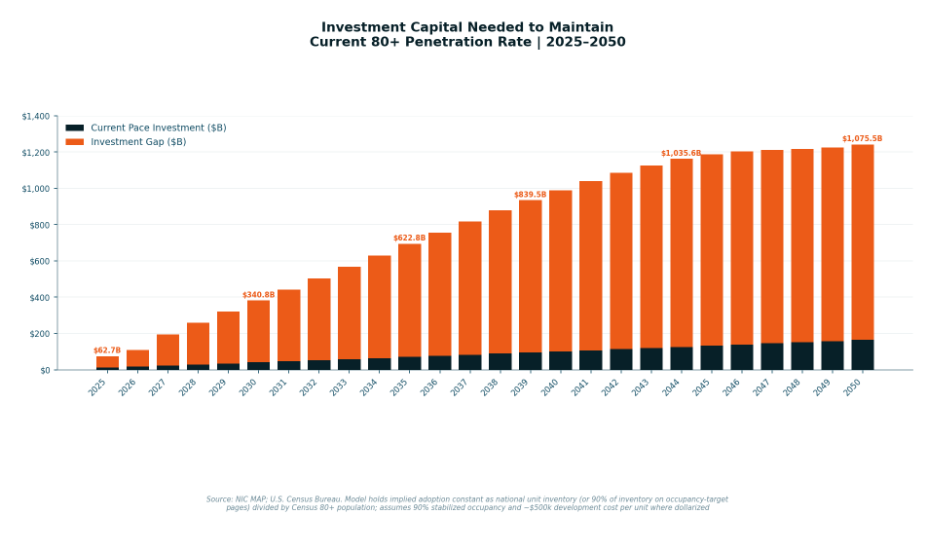
- Closing the senior housing supply gap requires more than $1 trillion in cumulative investment through 2050, according to NIC MAP.
- In most years through 2035, the market needs roughly 100,000 new senior housing units a year. The industry is delivering closer to 10,000.
- At today’s pace, the cumulative senior housing pipeline gap reaches nearly 1 million units by 2035.
- Occupancy, absorption, and transaction volume have all strengthened while construction has slowed, which turns a supply problem into a capital thesis.
Two years ago, NIC MAP’s first Senior Housing Market Outlook quantified the development gap facing the industry. The second edition arrives with a larger number attached. The senior housing pipeline gap has widened, not narrowed, and the capital required to close it now exceeds $1 trillion through 2050. That figure is one of the largest unmet capital deployment openings in commercial real estate, set against a demographic curve that runs on a fixed schedule rather than an economic one.
The senior housing pipeline gap is the growing distance between how many units the market needs and how many the industry is building. According to NIC MAP, meeting demand in most years through 2035 requires roughly 100,000 new senior housing units a year. Current development sits near 10,000. At that pace, the cumulative gap reaches close to 1 million units by 2035 and drives more than $1 trillion in required investment through 2050.
How Big Is the Senior Housing Pipeline Gap?
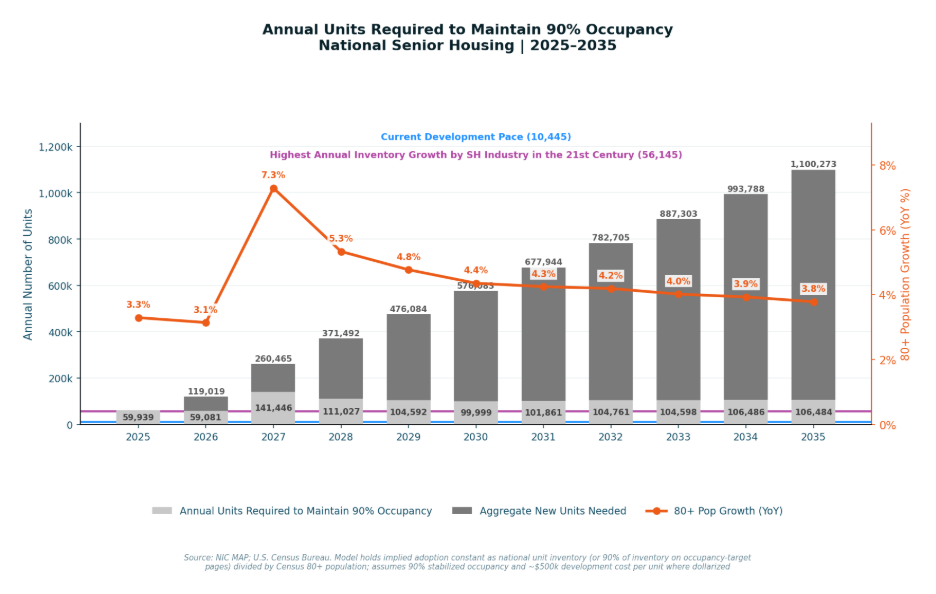
The gap is large and it compounds. NIC MAP’s model shows that holding today’s senior housing occupancy against the 80+ population’s growth curve requires more than 100,000 new units a year through most of the period ending in 2035. The industry is currently developing about 10,000 units a year, roughly a tenth of the requirement.
That shortfall does not stay flat. Each year of underbuilding adds to the total, pushing the cumulative build-out to nearly 1 million units by 2035. Translated into capital, maintaining today’s level of senior housing availability for the growing 80+ population requires more than $1 trillion in cumulative investment through 2050. That figure is the floor, the minimum capital needed to hold the existing penetration rate constant as demographic demand accelerates. For developers, lenders, and institutional allocators, that number sets the scale of what remains to be built.
Why Hasn’t Senior Housing Construction Responded?
Construction slowed for the same reasons it slowed across commercial real estate: elevated interest rates, construction costs that repriced sharply after 2020, and persistent labor constraints. Those forces cut senior housing development starts by roughly two-thirds since 2021, according to NIC MAP, dropping the pace to about 10,000 units a year. What is specific to senior housing is what waits on the other side of those headwinds. The 80+ population, the sector’s primary demand driver, does not pause for a rate cycle. The first Baby Boomers turned 80 in 2026, and that cohort expands by one-third by 2030 and nearly doubles by 2040. Every year construction stays constrained narrows the lead time before that demand arrives in full.
A Capital Story, Not Just a Construction Story
The two editions of NIC MAP’s Senior Housing Market Outlook together establish that the build-out opportunity has strengthened over time, not weakened. Operating fundamentals moved in the same direction as the supply gap widened. Industry-wide occupancy climbed more than 200 basis points in each of the last four years, according to NIC MAP. REIT NOI margins expanded across the same period. The sector absorbed record net move-ins over the last four years while construction starts sat near generational lows.
That combination, proven demand paired with constrained supply and improving fundamentals, is what moves the senior housing pipeline gap from an operational concern to a capital thesis. Transaction volume topped $15 billion in 2025, an industry high, according to NIC MAP. Senior housing led all property types in NCREIF returns at a 10.6% one-year total return, more than 400 basis points ahead of the next category. Capital has already begun pricing in what the demographic data has shown for years.
Key Takeaways
- The senior housing pipeline gap requires more than $1 trillion in cumulative investment through 2050 just to maintain today’s level of availability.
- Meeting demand in most years through 2035 requires roughly 100,000 new units a year, against a current pace near 10,000.
- The cumulative unit gap approaches 1 million by 2035, and it grows with every slow construction year.
- Occupancy, margins, and transaction activity have all strengthened as supply has tightened, turning the gap into a capital opportunity rather than a warning sign.
- The 80+ population’s growth curve is fixed by census data, not economic cycles, which sets a hard deadline for capital deployment.
What Comes Next for Senior Housing Capital
The senior housing trends that matter most now are the ones showing where demand is locked in, where the operating environment has strengthened, and where the capital need is large and durable enough to define the path forward. The build-out ahead is the story. The trillion-dollar figure through 2050 is where it starts.
For the full model and data behind these figures, see NIC MAP’s 2026 Senior Housing Market Outlook.
Frequently Asked Questions
How many senior housing units need to be built each year?
According to NIC MAP, most years through 2035 require roughly 100,000 new senior housing units annually to maintain today’s occupancy levels against the aging 80+ population. Current development sits near 10,000 units a year, a fraction of that requirement.
How much capital is required to close the senior housing pipeline gap?
NIC MAP estimates that maintaining today’s level of senior housing availability requires more than $1 trillion in cumulative investment through 2050. That figure is the minimum needed to hold the existing penetration rate constant, not an aspirational target.
Why is senior housing construction near historic lows?
Construction starts fell due to elevated interest rates, sharply repriced construction costs, and ongoing labor constraints, the same factors that slowed development across commercial real estate. Senior housing demand, tied to the fixed 80+ population curve, has not slowed alongside it.
What does the senior housing supply gap mean for investors and developers?
The gap represents one of the largest capital deployment opportunities in commercial real estate. Combined with rising occupancy, expanding margins, and record transaction volume, it shifts the pipeline shortfall from a construction problem into a long-term capital thesis for developers, lenders, and institutional allocators.
When does senior housing demand peak?
The 80+ population, senior housing’s primary demand driver, expands by one-third by 2030 and nearly doubles by 2040. That growth curve is set by census counts of people who are already alive today, which makes the timeline largely fixed rather than dependent on economic conditions.