
Senior Housing Market Metrics Show Record Deal Pricing Above $200K

October 15, 2026
Updated: October 15, 2026

Individual senior housing communities have traded well above $200,000 per unit for years. The market-wide average tells a different story. Across all senior housing transactions, the four-quarter average price per unit peaked just above $200,000 in 2019, then fell by more than 40% through the pandemic years and the interest rate shock that followed. That average has now moved past its prior peak, and of all the senior housing market metrics capital watches, few say more about investor conviction than what buyers pay per unit across the market as a whole.
The four-quarter average price per unit for senior housing transactions reached nearly $210,000 in 3Q26, above the prior high of $208,000 set in 3Q19. Trailing four-quarter transaction volume reached $21.5 billion over the same period, the highest total in NIC MAP’s series. Higher prices, more than a larger number of deals, account for most of that growth.
Price Per Unit Sets a New High
The climb has been steady rather than sudden. Four-quarter average price per unit (PPU) for senior housing transactions passed $175K in 3Q25, reached nearly $200K in 2Q26 and rose to nearly $210K in NIC MAP’s 3Q26 collection period. That figure surpasses the prior high of $208K set in 3Q19. It also puts pricing 19% above year-earlier levels and roughly 82% above the 1Q24 low of about $115K.
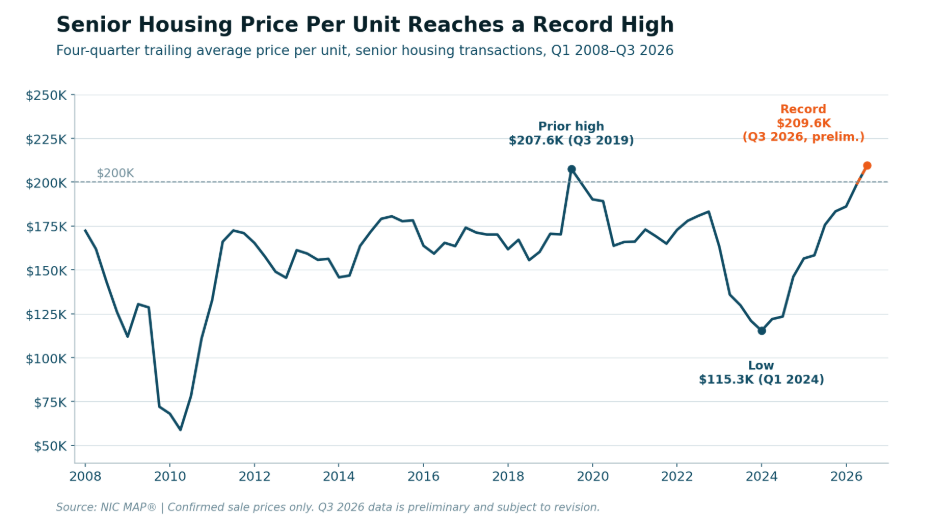
Four-quarter trailing average price per unit, senior housing transactions, Q1 2008–Q3 2026. Source: NIC MAP®. Confirmed sale prices only. Q3 2026 data is preliminary.
Price Is Driving Volume Growth
Dollar volume tells the same story from a different angle. Trailing four-quarter senior housing transaction volume reached $21.5 billion in 3Q26, up 42% from a year earlier and the highest four-quarter total in NIC MAP’s transaction series, which begins in 2008. Volume has risen for 10 consecutive quarters.
The source of that growth has shifted. Over the past year, dollar volume grew roughly three times faster than the number of properties changing hands. Higher prices, more than a larger number of individual transactions, are now doing most of the work.
NIC MAP’s 2026 Senior Housing Market Outlook described record 2025 volume as evidence that buyers and sellers were agreeing on terms at scale, narrowing the bid-ask spread and giving lenders and investment committees confidence that the sector can be underwritten and transacted. Four quarters later, buyers and sellers are agreeing on terms at higher prices.
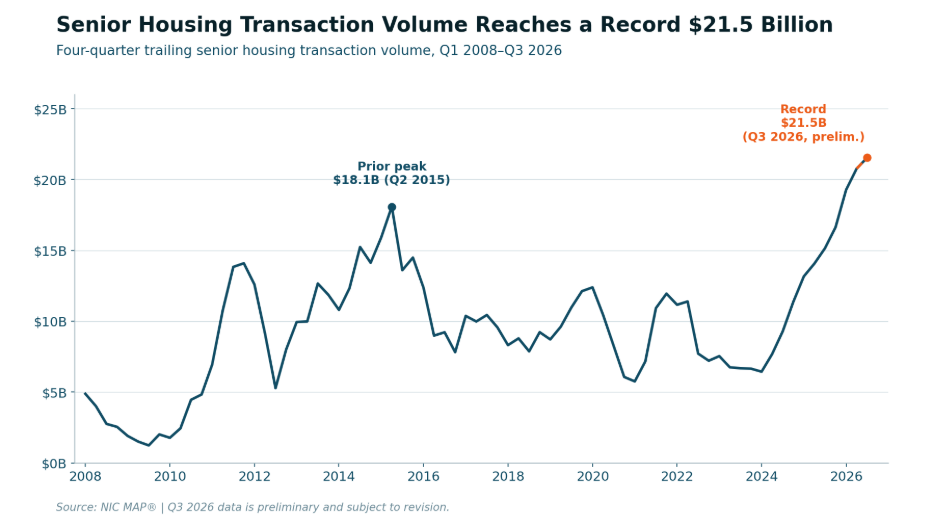
Four-quarter trailing senior housing transaction volume, Q1 2008 to Q3 2026. Source: NIC MAP®. Q3 2026 data is preliminary.
The Top of the Market Is Setting the Pace
The headline average deserves a careful read. Pricing is rising across the market, but not at the same speed. Transactions at the lower, middle and upper ends of the price range all traded at higher prices per unit than a year earlier. The top end has simply moved much faster.
Newer, higher-quality communities in high-barrier locations, often bought by public REITs and institutional investors, have accelerated well ahead of the rest of the market. That acceleration is what is widening the gap between top-tier and mid-market pricing. The middle and lower tiers are not slipping. They are climbing at a steadier pace while the top end moves ahead.
This pattern matches what the Senior Housing Market Outlook found, and what NIC MAP transaction data has shown for several quarters: newer communities lead pricing because they are easier to underwrite and attract capital willing to pay for quality, while older cohorts continue to improve at a more measured pace.
Recent publicly reported transactions illustrate the top end:
- Welltower acquired a 339-unit community in Woodland Hills, California, that opened in 2022, for $230.3 million.
- Nuveen acquired a community in Lincolnwood, Illinois, for $212 million.
- Artemis Real Estate Partners acquired a 207-unit community in Delray Beach, Florida, completed in 2023, for $140 million.
- Stonepeak acquired a 168-unit community in Las Vegas that opened in 2024 for about $83.1 million.
Fundamentals Support the Move
Record pricing needs a reason, and the operating data supplies one. In NIC MAP’s Primary Markets, senior housing occupancy reached 90.4% in 3Q26, up about 175 basis points from a year earlier. Demand is filling existing communities faster than the industry is adding new ones.
New development remains difficult to pencil. Elevated interest rates, higher construction costs and labor constraints have kept starts low, and the Senior Housing Market Outlook reported that construction starts fell 67% between 2021 and 2025. Inventory grew less than 0.5% over the past year, and the 16,159 units under construction represent about 2.3% of existing inventory.
That combination is redirecting capital. Investors seeking exposure to rising occupancy are acquiring existing communities rather than building new ones, which helps explain why transaction activity has climbed so sharply while the construction pipeline has thinned. Replacement cost adds context. The market’s average trade still sits well below the cost of building new, even as the newest communities trade above it.
What to Watch Next
The open question is whether the rest of the market closes the distance or the top end keeps moving ahead. With occupancy tightening and new development still hard to pencil, the pace of mid-market pricing is the part of the senior housing market metrics picture worth following most closely. NIC MAP’s quarterly transaction data tracks price per unit, volume and deal activity across markets and property types, so that spread can be measured each collection period. Contact NIC MAP to explore sector-wide transactions.
A Note on the Data
All figures reflect NIC MAP’s 3Q26 collection period and cover senior housing properties only. Four-quarter PPU reflects confirmed sale prices. Transaction data is preliminary at each quarterly release and subject to revision as NIC MAP collects additional closed transactions. Deal details above come from public company announcements and press reports.