
4 Senior Housing Trends to Know for 2025

January 27, 2025
Updated: May 20, 2026
This year, NIC MAP hit 18,695 analyses run by our customers.
That’s 18,695 opportunities to dig deeper into the senior housing market so we can better understand the trends shaping the industry—and forecast what comes next in 2025. With demand at an all-time high and new development struggling to keep pace, we’ll see continued pressure on operators and residents alike.
1. The Pandemic Rebound is Complete
COVID-19 disrupted every aspect of operations for the senior housing sector. Four years later, we’re seeing renewed confidence among operators and residents alike, driven by effective pandemic response measures, stabilized operations, and an increase in demand for care.
Senior housing demand is at an all-time high, with annual absorption rates—essentially, the speed at which units sell—exceeding 35,000 units per year over the past three years, compared to under 20,000 annually from 2015 to 2019. For three consecutive years, absorption has outpaced inventory growth, resulting in significant occupancy gains. This points to a high-demand market.

This growth reflects not only recovery but also a big shift in demand dynamics. The sector’s resilience during a period of global upheaval has reinforced its reputation as a need-driven asset class.
It’s time to move beyond recovery metrics and focus instead on how to meet this increase in demand.
2. Rapid Senior Population Growth Drives All-Time High Demand
This year, the market will enter a new phase of sustained demand trajectory as the aging population—notably Baby Boomers, the generation born between 1946 and 1964—drives market fundamentals. As the first Boomers turn 80 this year, demand will only increase.
We’re already seeing this through several different demand metrics in 2024. Occupied units in primary and secondary markets surged to over 950,000 by the end of 2024, a substantial increase from 876,000 in Q1-2020. As of Q4-2024, senior housing occupancy in primary and secondary markets reached 87.7%, up from 85.6% in the prior year. This represents a sustained annual increase of over two percentage points, a pace that illustrates the extent of the supply-demand imbalance.

In 2025, this trend suggests a continuation of rapid occupancy growth. Stabilized properties already are holding at 88.8%, which means we could see occupation numbers crack 90% industry-wide by year-end.
Operationally, now is the time to evaluate your ability to scale not just your supply but how you deliver a great customer experience for residents and caregivers. The most successful businesses will have robust plans for scaling service delivery, accessible facility design, and an integrated, technologically-savvy strategy to accommodate this new generation of senior housing customers.
National trends often look different at the metro level. Explore how market dynamics vary across regions in our latest deep dive.
3. Demand Outpaces Supply, Making New Development Urgent
Despite the demand surge, construction activity has not kept up—not even close. At its peak, the industry had 70,000 units under construction in 2019; today, that number has fallen to just over 31,000.
But what makes this more challenging is the leading indicators also point to a lack of supply in the future. In 2024, fewer than 10,000 construction starts occurred in primary and secondary markets—a nearly 40% year-over-year decline and the lowest annual total since 2009. When new starts fall behind, the gap between demand and supply will continue to grow.
The drivers behind this gap are familiar: elevated construction costs, labor shortages, and a constrained lending environment. In the short term, the imbalance pushes industry occupancy higher and sets the stage for sector-wide rent growth — historically how tight commercial real-estate markets play out. With developers struggling to keep pace, more attention is turning to reinvestment in existing properties to meet what residents and their families are looking for.
The long-term picture is more concerning. A constrained pipeline underscores the value of a disciplined approach to new development and acquisitions, and in real estate, it always comes back to the location. Market-by-market data on demand, supply, and construction starts is what tells capital providers, lenders, and developers where new construction is needed — and where the demand is already there waiting.
Simultaneously, policymakers must address systemic issues stalling out construction efforts so that the industry can meet the needs of an aging population. Operators can, and should, work with local governments to show how they benefit a market and serve the community.
4. Annual Rate Increases Normalize
After years of volatility due to the pandemic and rising inflation, we’re finally seeing annual rate increases begin to stabilize. In 2024, Majority Independent Living properties experienced 4% year-over-year rent growth, while Majority Assisted Living properties trended toward 4.3%. These figures represent a consistent and predictable stabilization of annual rent increases compared to the zig-zag over the past few years from a deceleration during the pandemic and a rapid rebound driven by inflation.
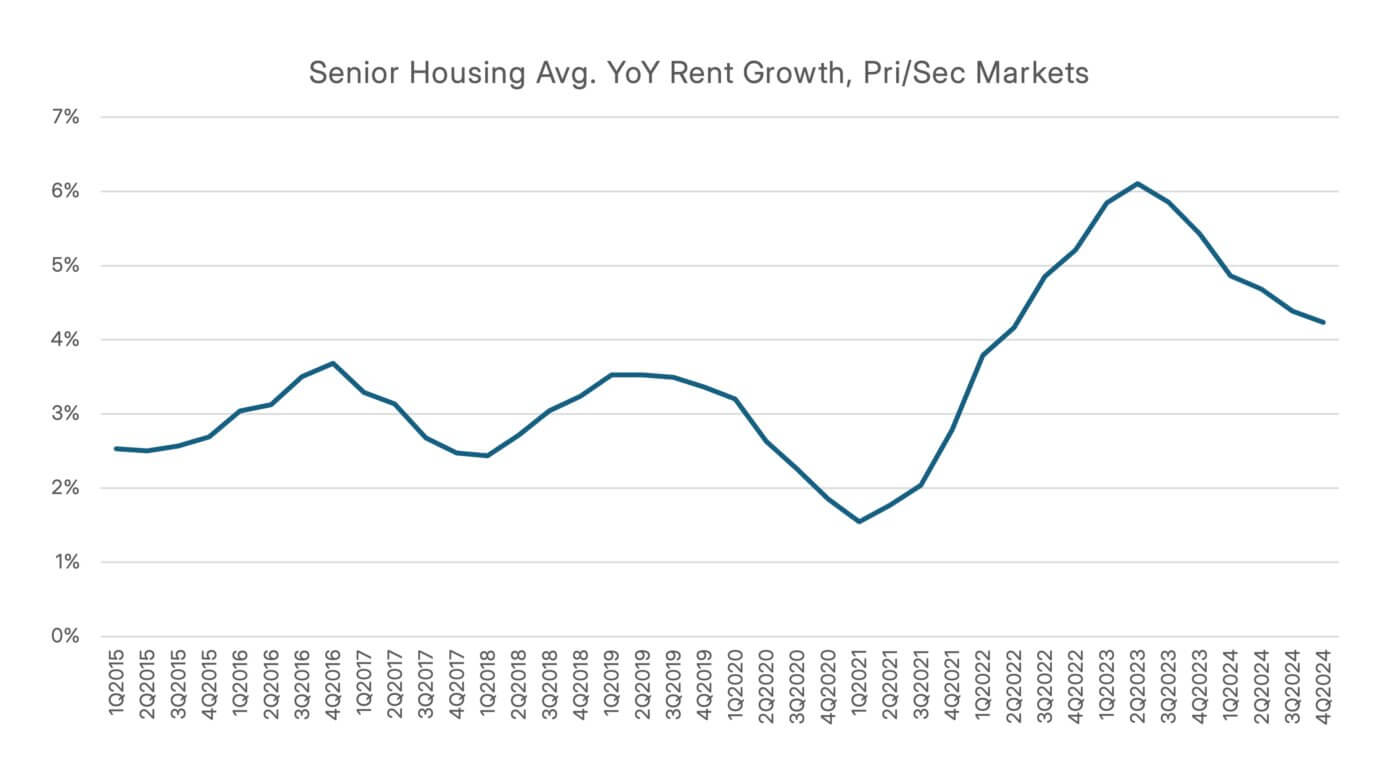
This normalization benefits both operators and residents. For operators, consistent rate increases provide the stability needed for financial planning and operational investments. For residents, affordability remains a significant concern. The moderation of rent growth compared to recent years can help mitigate the impact of rising costs on monthly budgets.
In 2025, this new equilibrium is likely to hold, with 4% annual rent increases becoming the standard across property types. The combination of steady rent growth and rising occupancy is a constructive backdrop for the sector — and one that lenders, capital providers, and federal agencies underwriting senior housing are tracking closely as they size up the next wave of demand.
A Call to Action: Preparing for the Future
The senior housing industry is positioned for rapid growth. Now is the time to get ready to scale your operations, either through new acquisitions or sponsoring new development. A historic shift in demographics means this senior housing demand wave is only just beginning.
The best way to know where to go next with your business? The right data. NIC MAP’s Senior Housing Market Outlook provides deeper insights into these trends, offering a roadmap for stakeholders to navigate the opportunities and challenges ahead. Download the report to explore the data behind these insights and prepare for a new era of transformation in the senior housing industry.